Spiti Valley Road Trip Guide: Route, Best Time, Budget & Permits
Spiti Valley is commonly referred to as the “Middle Land,” the “Land Bridge” between India and Tibet, and is a frozen desert at a very high-altitude, a place that is akin to another planet. A road trip to Spiti Valley is not a holiday, but a pilgrimage for modern-day travellers. Unlike the green valleys of Lower Himachal, Spiti has a rugged, rocky quality, its landscape dominated by wind-swept gorges, Buddhist monasteries on the face of mountains and blue rivers passing through a brown and grey terrain. Spiti remains one of the most sought-after destinations on the global adventure route. It is because Spiti has an average elevation of 3,800 meters, certain precautions must be taken.
About Spiti Valley:
Spiti is a trans-Himalayan subdivision of the Lahaul and Spiti district. It is separated from Kullu Valley by the Rohtang Pass, and from the Lahaul Valley by the Kunzum Pass.
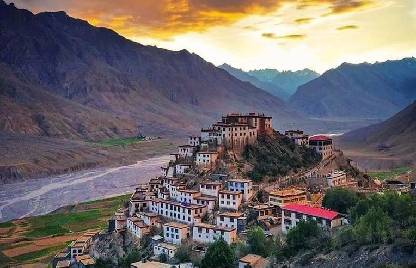
The rich culture is largely dominated by Vajrayana Buddhism, as found in Tibet and Ladakh. The monasteries of Tabo and Key, which are over a thousand years old, represent the spiritual heart of the region. The valley is also home to some of the loftiest habitations in the world, like Komic and Kibber, where live the Spitians of exceptional simplicity and warmth.
Best Route to Follow: There are two different routes to enter the Spiti Valley. The common recommendation among seasoned travellers is to follow what is called the “Spiti Circuit,” which involves entering from one side of the valley and then exiting at the other side.
Route 1:
This is the most sought-after route because it gradually climbs the mountains and therefore reduces the risks associated with Acute Mountain Sickness. The route takes the travellers through the following places: Delhi – Shimla – Narkanda – Sangla/Chitkul – Kalpa – Nako – Tabo – Kaza. The major attractions include the trip over the “World’s Most Treacherous Road,” in the state of Kinnaur, a view of the mummy at Gue, 500 years old.
Route 2:
This is shorter and steeper. It is open for just 4 to 5 months in a year (June to October). The route covers Manali – Atal Tunnel – Gramphu – Batal – Kunzum Pass – Kaza. The points of interest on this route lie in crossing the river at Chhatru and stopping over at Chandratal Lake, Crescent Shape. To do it in the best way, one should start from Shimla and end in Manali. One gets to see how the landscape varies from Dense green forests to an arid desert.
When is the right time to go?
It’s a “rain shadow zone,” and this indicates that monsoons from the Indian side rarely go over the mountains into the valley below. This is actually a great time to be in the region because the rest of the India is being pounded by the monsoons.
Summers (May to June) – Clear roads, pleasant days and cold nights.
Monsoon (July to September) – Spiti is dry, but access roads face landslides.
Autumn (September to October) – Crystal clear blue skies, golden landscapes, perfect for photography.
Winter (November to April) – Extreme cold, the “White Spiti” experience.
What’s the appropriate budget for the Spiti Valley Road Trip?
A road trip to Spiti can be as frugal or as comfortable as you choose. The following is an estimated budget for a 9-day trip starting and ending in Delhi/Chandigarh:
Budget travellers: ₹18,000 to ₹25,000
Remain in basic homestays/hostels. Enjoy food at local dhabas or guesthouse meals.
Mid-range travellers: ₹35,000 to ₹50,000
Options for accommodation include regular guest houses and homestays. Shared cost of an Innova or Scorpio.
Luxury/Private Tour: ₹60,000+
Spend nights at the best boutique hotels available in Kaza or enjoy a luxurious camping experience at Chandratal. It requires exclusively 4x4 transportation.
Is any permit required for the Spiti Valley Road Trip?
The permit requirements depend on your citizenship and route of choice.
For Indian Citizens:
Need no permission whatsoever to enter Kaza, Tabo or any other large village in the Spiti Valley. All you need is a government-recognized ID like an Aadhar Card, Voter's ID, etc.
If you want to proceed towards Kaza from Manali through Rohtang Pass instead of the Atal Tunnel route, then you need to possess a permit for Rohtang Pass.
No need for any permit when proceeding through the Atal Tunnel.
For Foreign Nationals:
A Protected Area Permit is close to the Tibetan Territory; every foreigner needs an Inner Line Permit to travel between Reckong Peo and Kaza, specifically at Sumdo Checkpoint.
This form can be obtained from the District Magistrate’s office, either in Shimla, Rampur, or Reckong Peo.
These will probably consist of several persons, at least two, and a licensed travel agent.
Conclusion:
The journey from Kaza to Spiti Village in a road that will prove to be one of the most remarkable trips of your life. It will prove your lungs, your driving skills, and your definition of what needs to be in one’s life for one to be content. It speaks through the stillness of the mountains when you are seated along the Spiti River or in front of the large statue of the Buddha in the village of Langza. To get the most out of your holiday in 2026, remember the overriding rule of travel in the Himalayas.