Places to visit in Leh Ladakh
Leh Ladakh is a huge, dry, and visually stunning region of Northern India, famous for its “Land of high Passes.” Leh Ladakh is nestled high-up in the Himalayas, possesses striking mountain scenery with deep turquoise lakes and timeless Buddhist temples. Travellers are allured by seeing its contrast of adventure, spirituality, and culture.
The sightseeing attractions of Ladakh are broadly divided into natural wonder and cultural/historical landmarks, comprising high-altitude passes and pristine lakes, centuries-old monasteries, and monuments in Leh, the capital city. A typical itinerary is so planned that besides giving time for acclimatization to the severe altitude.
Pangong Lake – Pangong Tso means lake in Ladakhi, the most popular site in Ladakh. This endorheic lake lies at an altitude of around 4,350 meters, famous for its attractive feature: during the day, the color of its water changes – sky blue, light green, and sometimes even deep crimson. One third of this lake lies in India, while the remaining two-thirds are under the region of Tibet. The lake freezes completely during winter since it is made up of salt water.
Khardungla Pass – Khardungla Pass is amongst the highest motorable passes in the world, though the exact altitude is sometimes disputed. It is an important connecting point between Leh and Nubra Valley. Crossing the pass is an adventure, with stunning views of the Siachen Glacier region and neighboring mountain ranges. Difficult terrain, high altitude, and snow-capped roads even in summer, makes it famous stopping site for cyclists and road travellers.
Magnetic Hill – Magnetic hill is a unique phenomenon, can be found on Leh-Kargil-Srinagar national highway. It is basically a gravity hill wherein a car seems to move uphill against gravity if parked in a defined area. It is an optical illusion, which causes the eye to see the downslope as upslope due to the surrounding scenery. It’s a famous and enjoyable destination for travellers to explore the photography.
Nubra Valley – Nubra Valley is a high-altitude cold desert, located to the north of Leh, and is reachable via Khardungla Pass. The sand-filled terrain with streaks of lush green riverbeds of the Shyok and Nubra rivers defines this valley. Its main sightseeing points are the sand dunes between the Diskit and Hunder, offering unusual double-humped Bactrain camel safari, a vestige of the ancient Silk route trade.
Tso Moriri Lake – Tso Moriri Lake is located at an altitude of around 4,522 meters or 14,836 feet in the Changthang area of Ladakh. It is a high-altitude lake and is the largest one completely in India. Unlike Pangong Tso, it’s a sweet-water lake and less explored, hence a Ramsar wetland protection reserve. Tso Moriri is surrounded by Trans-Himalayan mountains and affords a more private, tranquil, and visually stunning experience that often attracts wildlife lovers.
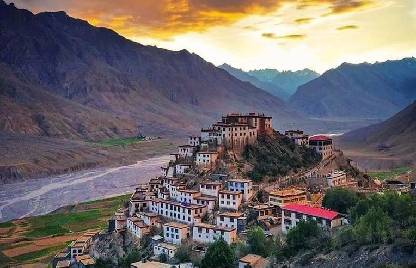
Lamayuru Monastery – The Lamayuru Monastery is one of Ladakh’s oldest and largest monasteries, located along the way from Leh-Kargil and dates to the 10th century. It is noted for its unique geological surroundings that give the appearance of a lunar landscape and hence has given it a name of “Moonland.” The monastery complex is huge with exquisite murals, thangkas and ancient scriptures, and houses a significant number of monks.
Diskit Gompa – Diskit Gompa is the largest and oldest Buddhist Monastery in Nubra Valley, dating back to the 14th century. The monastery is located on the hill overlooking the Shyok River and Nubra Valley. A huge 32-meter-tall statue of Maitreya Buddha, the Future Buddha, was installed by the Dalai Lama on the hillside. It looks over the Shyok River and is believed to protect this region.
Shanti Stupa – The Shanti Stupa is a big, white-domed Buddhist stupa constructed on the top of a hill in Changspa, close to Leh city. It was built by a Japanese Buddhist organization to encourage world peace and honor 2500 years of Buddhism. The stupa is a major landmark that offers the best panoramic views of Leh, the surrounding villages and the Indus Valley, particularly at sunrise and sunset.
Shey Monastery – Historically, Shey Monastery was used as a summer retreat by the Kings of Ladakh. The main attraction of this place, located around 15 kms from Leh, is the spectacular, gigantic copper-gold gilded statue of Shakyamuni Buddha, standing 12 meters. The ruins of the erstwhile palace and monastery reflect the monarchical history of Ladakh before the Dogra invasion.
Kargil – Kargil is the second biggest town in Ladakh and lies on the Suru River. It acts as an important stopover between Srinagar and Leh. It is famous for the 1999 Kargil War and a memorial kept at Dras near Kargil, remembering the martyred soldiers. Many travellers pass by Kargil en route to Leh, yet the war memorial is a significant and serious stop for travellers.
Conclusion –
Leh Ladakh is a land of extremes: spiritual serenity of the monasteries, together with exhilarating roadways across high passes. The region offers a spiritual pilgrimage along with an unforgettable odyssey for the voyager. Its raw beauty and unique cultural landscape create an indelible impression on every visitor.